
Preparing the simulation and computing infrastructure for FCC-ee precision physics
Long before the first FCC-ee collisions take place, physicists are already studying its physics. Not in a detector, but in simulations capable of reproducing particle interactions and detector responses with unprecedented accuracy.

The FCC-ee aims to measure the properties of fundamental particles such as the Higgs boson with extraordinary precision. Achieving that goal will require not only billions of collisions and advanced detectors but also simulations capable of reproducing the underlying physics with remarkable accuracy. To fully exploit the FCC-ee precision physics potential, physicists and engineers must build a sophisticated software and computing infrastructure capable of handling vast amounts of data.
Simulating billions of collisions
One of the main challenges for FCC-ee physicists is the simulation of the billions of Z bosons the collider is expected to produce. Yet the challenge does not lie in the number of collisions but in the precision required for each of those events. This will imply the development of new simulation tools, based on the so-called Monte Carlo generators, that run fast enough so that physicists can simulate a large number of events.
“Even though the number of events in the FCC-ee is much lower than in the HL-LHC, the simulation time per event will be huge because we will need to reach an unprecedented level of detail,” explains Brieuc François, coordinator of the Physics software and computing group in the Future Circular Collider project.
A full particle detector behind the screen
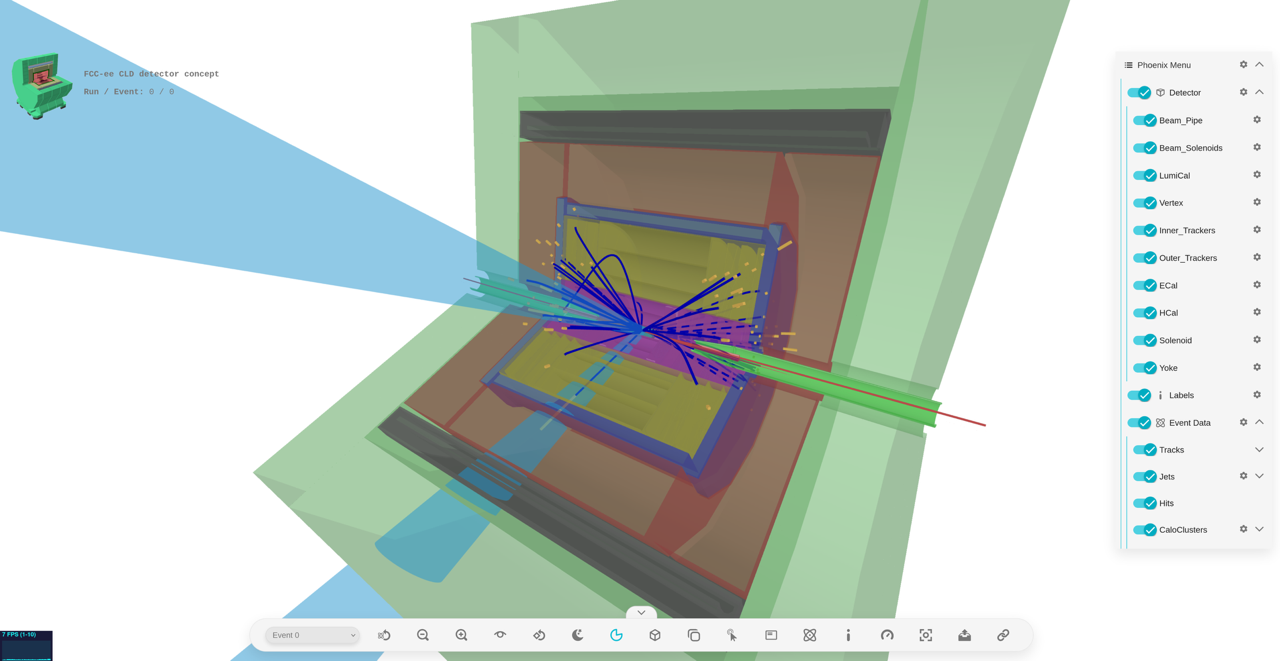
However, simulating what happens during the collision is just the first step. Once an electron and a positron collide, the resulting particles cross the detector and interact in diverse and complex ways. The main challenge is to accurately simulate the whole detector structure and the thousands of parts that make it up in the most realistic way.
Simulating the full detector is essential for evaluating its physics performance. First, it allows physicists to evaluate the detector’s physics potential and understand the scientific reach the FCC-ee can ultimately achieve. Second, simulations help optimize the detector design, also taking into account beam-induced backgrounds generated close to the interaction point.
❝
“It still needs some more fine tuning, but we can already do physics analysis with some of our models,”.
— Brieuc François
To accommodate the inherent uncertainties of an early-stage project, the detector simulation framework is being developed with flexibility at multiple levels, allowing detector geometries to be modified easily as the designs evolve. This modularity also enables physicists to efficiently explore and compare a wide range of detector configurations.
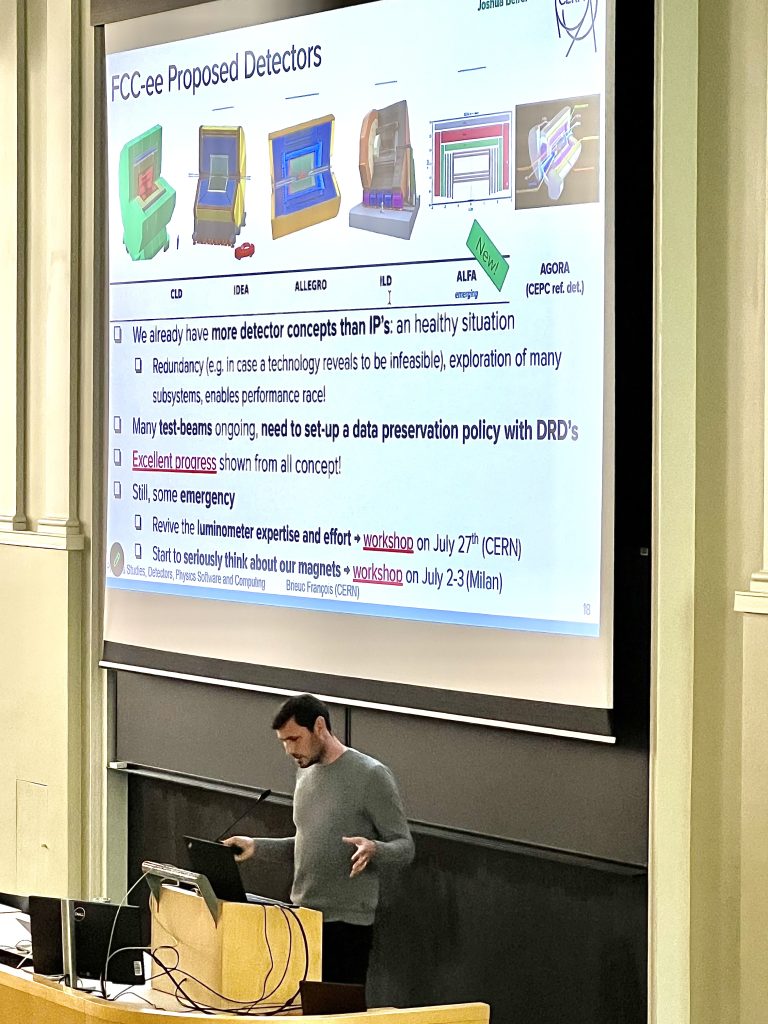
As an illustration of this flexibility, one of the proposed FCC-ee detector concepts is actually based on an adaptation of the International Large Detector (ILD), originally developed for the International Linear Collider (ILC), to meet the specific requirements of FCC-ee.
Although the development of detailed detector modeling is still a work in progress, all the steps of the simulation, digitization, and event reconstruction are already in place. “It still needs some more fine tuning, but we can already do physics analysis with some of our models,” explains François.
A Unified Computing System
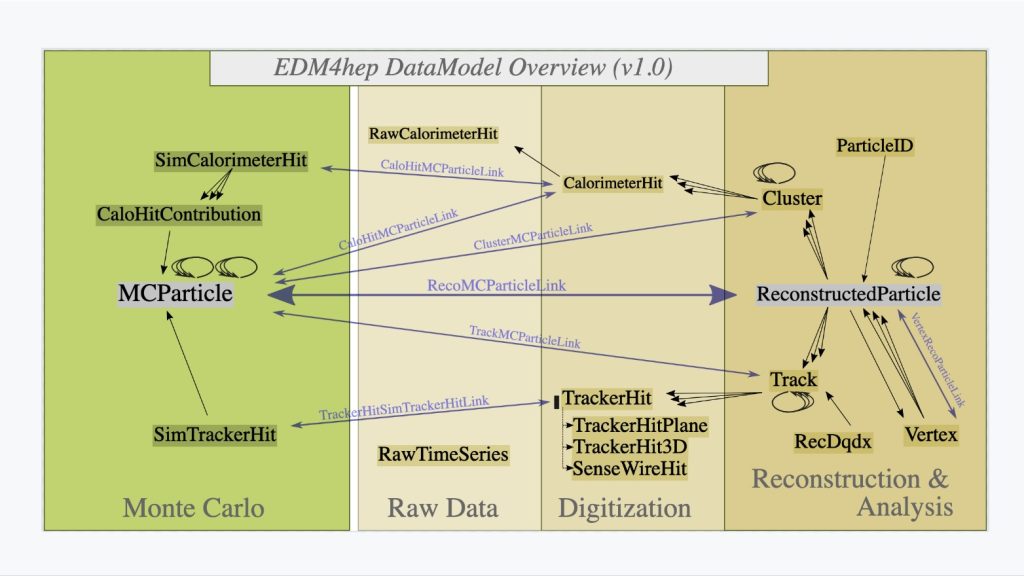
The computing infrastructure that FCC-ee scientists and engineers are designing is detector-agnostic. That principle should ensure considerable flexibility to adapt to the final detector design and requirements while serving all detector concepts simultaneously.
The overall computing architecture will be similar to the distributed infrastructure developed for the LHC. However, in the LHC each experiment ultimately developed its own software ecosystem. François wants this to be different in the FCC-ee: “We want to push the idea that the four detector concepts use the same computing models and computing tools.” A computing center responsible for the first stage of data processing will be installed next to each detector. Then, all data will be transferred to Tier-0, CERN’s primary data-processing centre in Meyrin.
The unification of the computing systems, however, represents a significant challenge because all experiments would need to agree on which tools to use. “This is a sociological challenge rather than a technical one,” notes François. The current computing infrastructure is based on DIRAC, a distributed computing framework. Originally developed by the LHCb collaboration is now being extended to meet the needs of FCC-ee. CMS is also exploring the possibility to use DIRAC for HL-LHC, “We are trying to join the FCC-ee and CMS efforts in the developments,” says François.
A collaborative software development
The FCC-ee computing systems will benefit from the many development synergies of the LHC upgrade to the HL-LHC. “It’s a good time to jump in and have common development of the two projects,” says François. For instance, the technology required to store all this data will be similar to the one being developed for the HL-LHC. However, the main challenge will be ensuring that such a large-scale infrastructure remains reliable over the long term.
When FCC-ee development began back in 2014, linear collider projects already had mature software infrastructures from which the project could draw inspiration. “Although the software had to be modernized and adapted to FCC-ee requirements, the project has benefited significantly from the developments originally carried out for CLIC and the ILC. “It was decided to prepare a new software ecosystem that would serve all the future colliders studies and the ability to call the existing linear collider code was preserved, providing an efficient start for this new framework” says François. This software ecosystem, known as Key4hep (https://github.com/key4hep), is now widely used and jointly developed by researchers across a variety of future collider studies.
AI enters the simulation chain
The computational demands of FCC-ee simulations are also driving interest in AI-based techniques. “AI will be everywhere,” notes François, who expects AI to play an important role in many aspects of the detector design where human capabilities may fall short. François points out that AI can help optimize the detector design by generating multiple design options quickly and comparing them. AI will also help the analysis of the data coming from the collisions even more than it already does with the LHC data. Integrating these AI models and retraining them whenever detector designs or operating conditions change represents a significant challenge.
Towards a complete integrated simulation
The next two years of development will be devoted to completing the simulation of all detector concepts. In parallel, researchers will further develop the common computing model that will be the basis for all of them. The goal is to have this model before each detector concept begins implementing its own design and before the opportunity for a common computing infrastructure is lost.
❝
“There will be only one FCC this century. We need to work hard to have the best detectors we can in order to make the most out of the data that will be produced at the FCC-ee,”
— Brieuc François
For FCC-ee physicists, the challenge is therefore not only to build the machine and detector themselves but also the software and computing ecosystem needed to fully exploit its scientific potential. “There will be only one FCC this century. We need to work hard to have the best detectors we can in order to make the most out of the data that will be produced at the FCC-ee,” concludes François.