
R&D boosts FCC detector technologies
Recent beam tests at CERN North Area, tested high-precision muon detector technologies for the IDEA detector concept. These experiments are part of the detector FCC-ee intense R&D carried out before the long LHC shutdown.

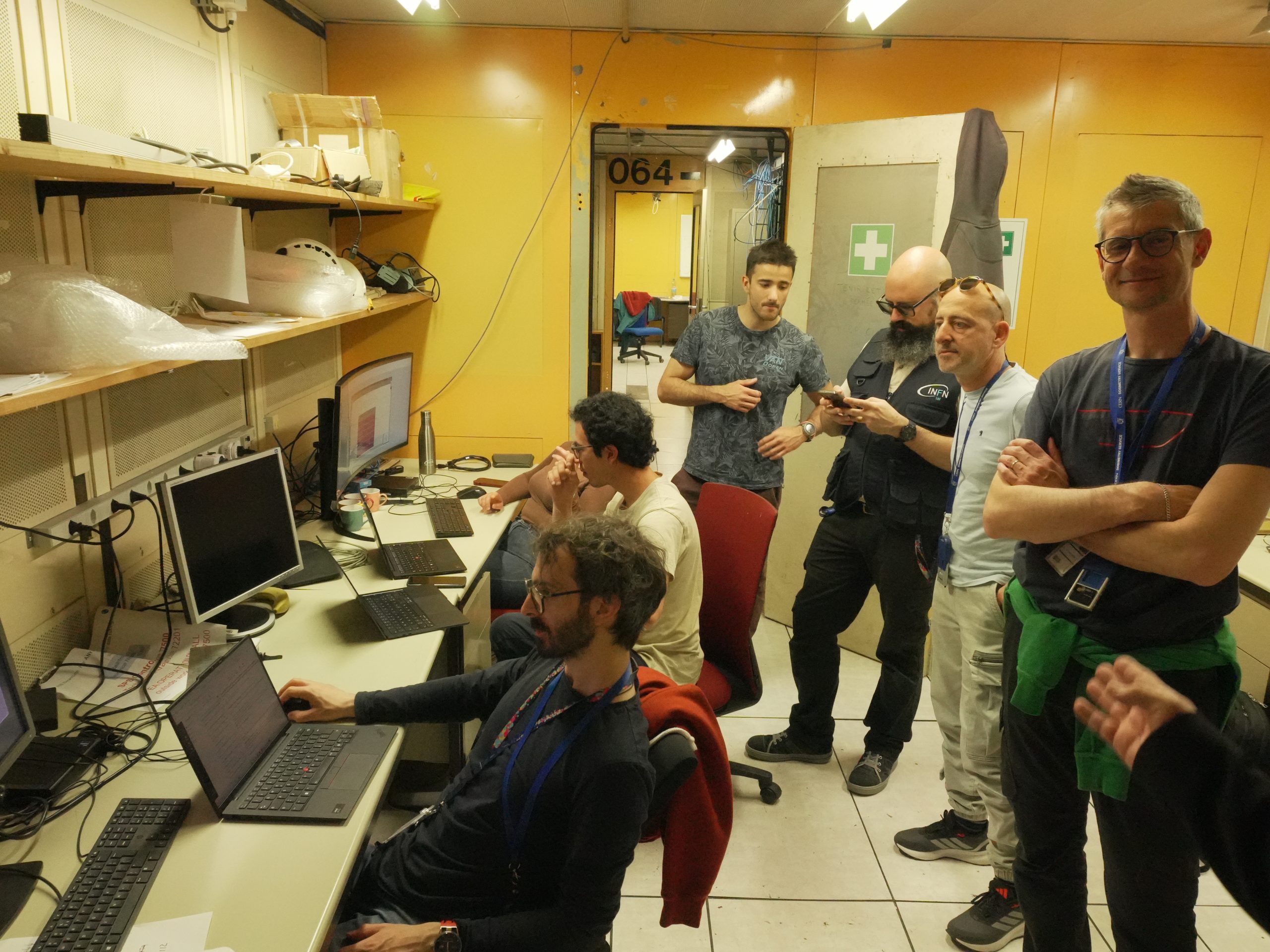
The first test beams of the LHC detectors date from 1993, sixteen years before they saw the first protons. In the same manner, the R&D of many of the FCC detectors already started time ago. To develop new detector technologies, different teams of the IDEA detector concept, one of the FCC-ee detector concepts, have tested several prototypes with real beams in one of the last opportunities before the CERN accelerator complex shut downs for more than three years.
❝
First of all, we test the technology and the technique, but then we have to make sure that it can scale up to a full detector,”
— Paolo Giacomelli
These tests show that progress in the FCC does not only happen through simulations or concept schemes, but it has also taken the shape of real prototypes for many years. “It is much easier to get the project approved when your technology is already mature enough than when you have to do everything fro m scratch,” explains Paolo Giacomelli, senior researcher at INFN Bologna and responsible for the IDEA detector concept.
But one thing is the small prototype, and another thing is the large-scale detector, which may contain thousands of units of the tested prototype. “First of all, we test the technology and the technique, but then we have to make sure that it can scale up to a full detector,” says Giacomelli.
Micrometer spatial precision in muon detection
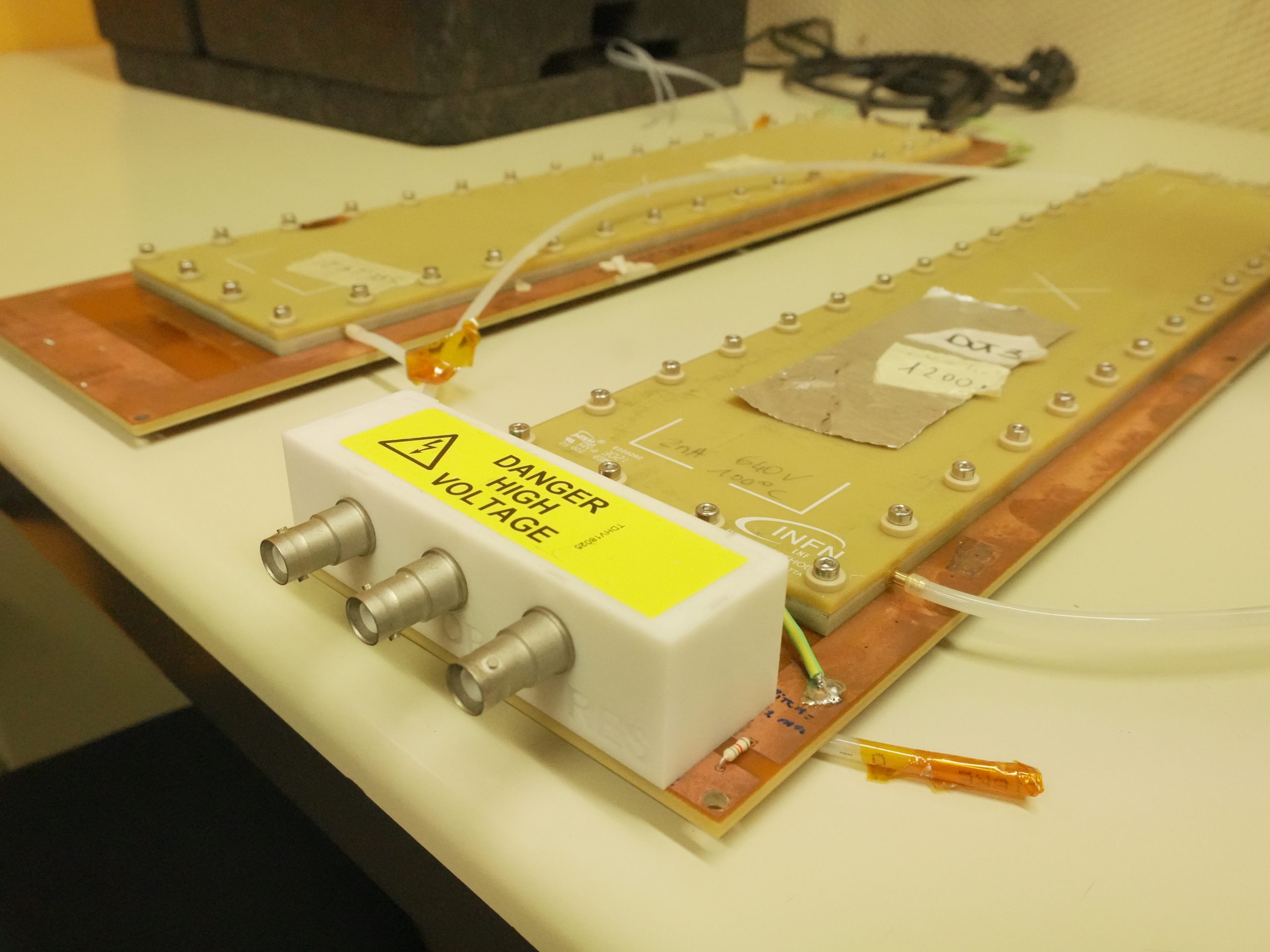
The muon technology tested recently is called micro-RWELL and belongs to a family of detectors known as “micro-pattern gas detectors (MPGD).” The fabrication techniques of this technology are mature and derive from photolithographic methods. “This is a well-established technology developed more than 15 years ago,” explains Giacomelli.
With a spatial resolution that can reach up to 50 microns, this muon technology provides a step forward in precision with respect to previous detectors such as the drift tubes installed in LHC experiments. However, for the IDEA detector, Giacomelli’s team will not push to that limit, as the new detector only requires about 200-300 microns of precision. “More precision means more channels and a higher cost. We have to find a compromise between how good it is and its cost,” says Giacomelli. With this space resolution IDEA’s muon detector will be able to do standalone tracking and momentum measurements and match these tracks with those found in the central tracking system ensuring high precision measurements. The muon detector should also be able to reconstruct secondary vertices produced a few meters away from the primary vertex. This characteristic could help to identify long-lived particles (LLP) suggested by several theories beyond the standard model (BSM) of particle physics.
The micro-RWELL detector consists of three layers. After a first metallic plate which acts as the cathode, the second layer consists of a small gap of about 7 millimeters filled with gas, and the third layer contains the PCB with the patterned anodic plane. Particles traverse the metallic layer, ionizing the gas, and then the resulting signal is collected on the PCB, which has a segmented anode in strips or pixels, and finally sent to the readout electronics.
Testing faster detector electronics
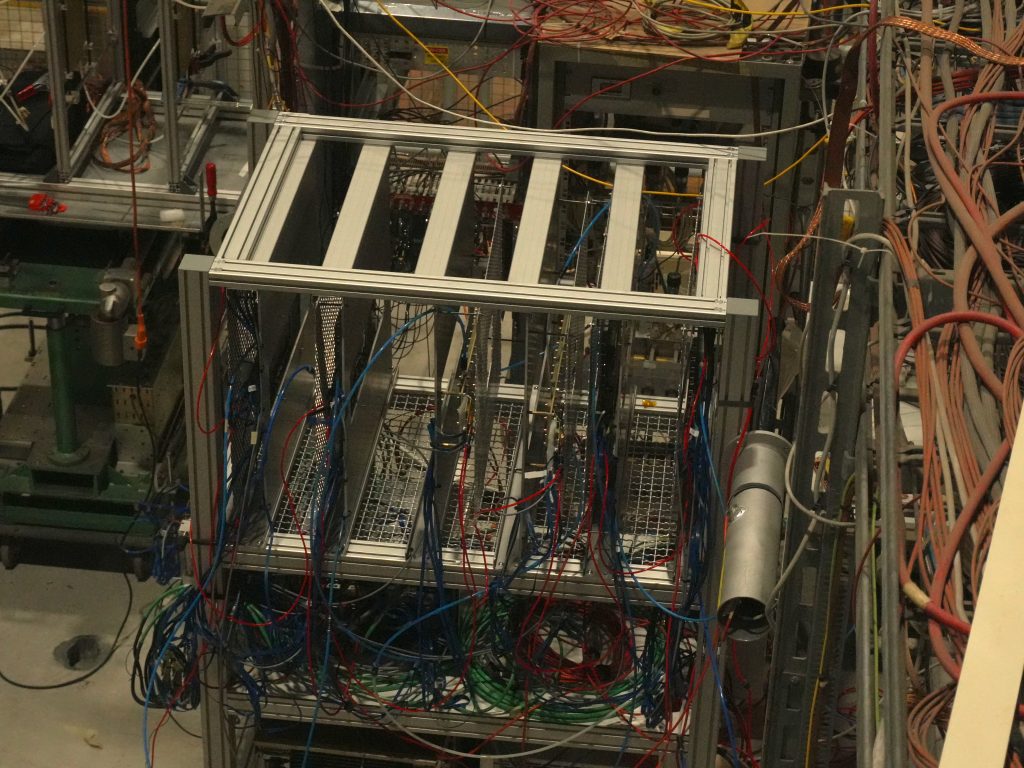
The micro-RWELL team prepared the tests for months, going through the approval process to get time at one of the last chances before the CERN accelerator complex shutdown. In the tests, the proton beam is extracted from the SPS at 400 GeV. “For FCC-ee we don’t really need such a high momentum, but sometimes we use it anyway as it provides higher particle rates,” comments Giacomelli. The extracted beam hits several targets and produces secondary beams. Secondary pion and muon beams are directed towards the H8 beamline of the CERN North Area, where the micro-RWELL team installed two detector configurations.
In the first configuration, they tested a new type of electronics designed to cope with high particle rates. The second test was dedicated to evaluating the pros and cons of different types of anode configurations that help develop two-dimensional readout from a single detector. While the first detector samples tested are mono-dimensional with 50-centimeter long strips, the detectors planned for the FCC-ee muon system will have a bi-dimensional readout, with two orthogonal layers of strips, of with several layers of pixels.
Testing detector prototypes is challenging and, as Giacomelli notes, “every aspect of the test can be a problem.” These setups are installed for a week or two, and electronics noise is a recurrent problem that requires screening everything, with several devices working in parallel that may spoil the data collection process. Conversely, radiation hardness does not represent an issue for these FCC-ee detectors, as it will be orders of magnitude below that of the LHC.
❝
We have years of intense R&D ahead.”
— Paolo Giacomelli
However, one of the main challenges of the full version of the detector that can jeopardize this high precision is the interaction of particles with inner layers of the detector. “Any material introduces deviation to the particle track and destroys the momentum resolution. That is why we would like to have as little material as possible, especially before the particles reach the calorimeters and then finally the muon system,” explains Giacomelli.
A technology that goes beyond the FCC
Micro-RWELL is one of the detector technologies considered for muon detection at the FCC. But it is not the only project that explores it. Despite the requirements being different, the LHCb muon spectrometer upgrade and probably the new Electron-Ion Collider at Brookhaven National Lab are also pushing in this direction. “In the LHCb, data rates are a factor of 100 or more higher compared to what we will have at the FCC. They need one megahertz per square centimeter, while we would never exceed 10 kilohertz,” explains Giacomelli.
An R&D roadmap
Thanks to the development over the years of this type of technology, the production of this muon detector technology is now easier and less costly than in the past. In five or six years, Giacomelli expects to have a full description of the technology required for the FCC-ee IDEA muon detector, including its size and the number of layers and channels, as well as the type of electronics. “We have years of intense R&D ahead,” concludes Giacomelli.
Testing other parts of the detector
The tests on the new muon detector technology were the first tests of a series of tests carried out in the CERN East and North areas using different IDEA subdetector technologies. Other tests involved the prototype of the drift chamber, which is proposed as the central tracker, the vertex detector, and also tests on both the crystal electromagnetic calorimeter of IDEA and the hadronic calorimeter. Both calorimeters are dual readout: they read at the same time the Cherenkov and the scintillating light. This allows to extract, on an event per event basis, the fraction of the electromagnetic component of the shower and obtain the corrected energy.