
Towards a Joint Dual-Readout Calorimeter
Researchers from Italy and the United States have successfully completed a series of beam tests of dual-readout calorimeter prototypes at CERN’s North Area.

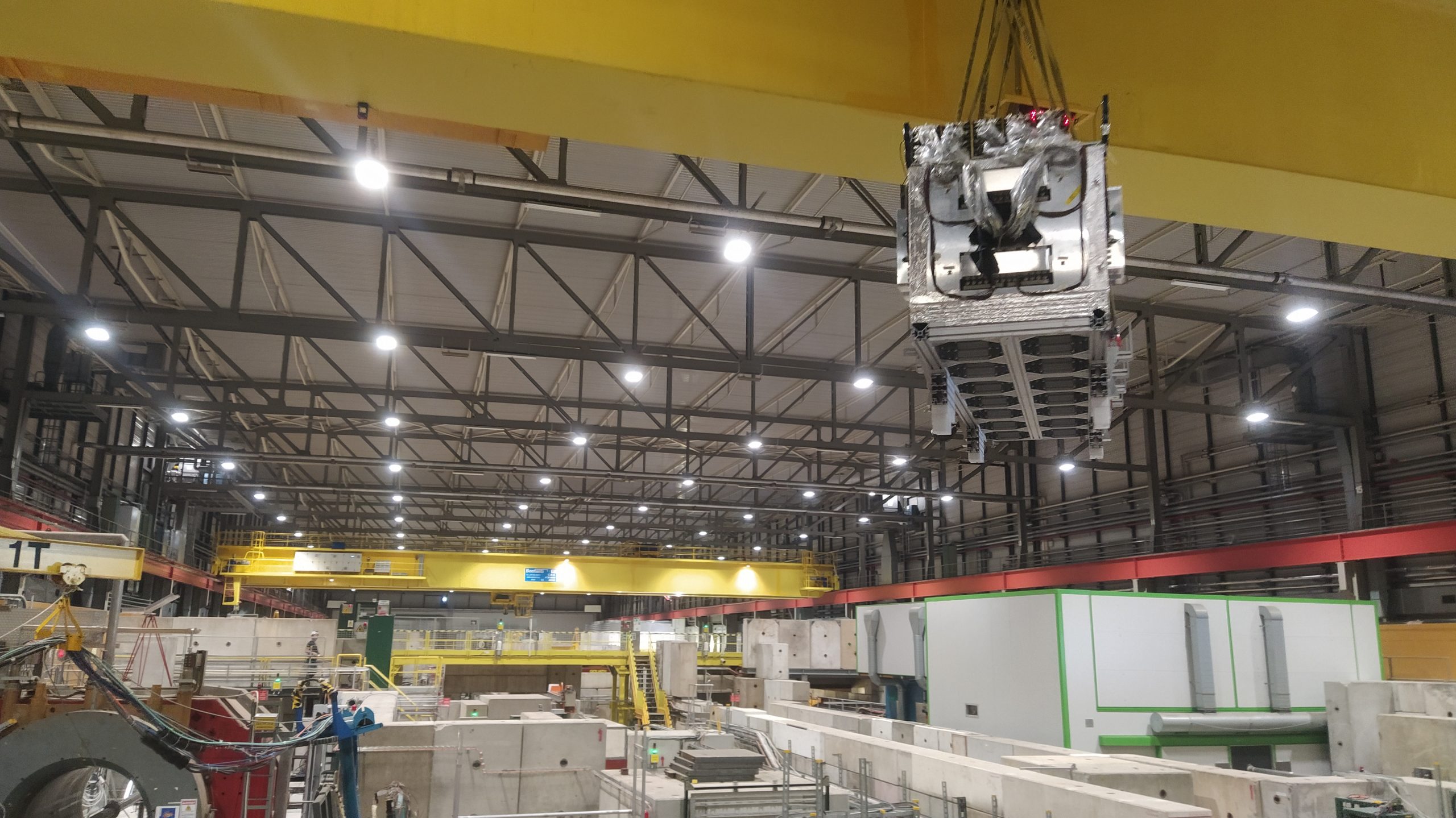
In one of the last opportunities to test detector prototypes before CERN’s accelerator complex enters Long Shutdown 3, a beam test campaign brought together teams from Italy and the USA to experiment with complementary calorimeter technologies. These tests highlighted the efforts made to unite separate R&D programmes into a single calorimeter concept for the FCC-ee. Within this collaborative framework, researchers share data acquisition software, coordinate their beam-test schedules, and make use of common infrastructure during the limited test-beam periods available at CERN.
Precision detector technology
The FCC-ee physics programme requires unprecedented energy resolution, driving the development of new detector technologies. Dual-readout calorimeters are designed to improve the precision of hadron energy measurements by recording two independent signals from particle showers. The detector uses two types of optical fibres: scintillating fibres, which respond to almost all charged particles, and undoped fibres, which are primarily sensitive to Cherenkov light produced by the fastest particles in the shower. By combining these two measurements, researchers can reconstruct particle energies with significantly greater accuracy than conventional hadronic calorimeters.
Recent beam tests combined two complementary calorimeter approaches. On the one hand, the Italian INFN team led by Paolo Giacomelli developed a new calorimeter prototype to optimise the detector’s absorber and fibre geometry. Just after the tests of the first prototype, a US-based team led by Christopher Madrid, a researcher at Texas Tech University, focused on testing a second prototype with advanced readout electronics capable of measuring photon arrival times with a precision of around 50 picoseconds. Such timing information would allow researchers to determine the precise location where the energy is deposited along the detector, which can help separate overlapping particle showers, improving the reconstruction of jets.
The tests conducted by Madrid and his team aimed to eliminate the background noise observed during last year’s tests that hindered the identification of individual photon hits. “Our signal-to-noise ratio was terrible. Now you can just look at the output and count the photons coming in by eye. It’s beautiful. We’re very happy,” says Madrid.
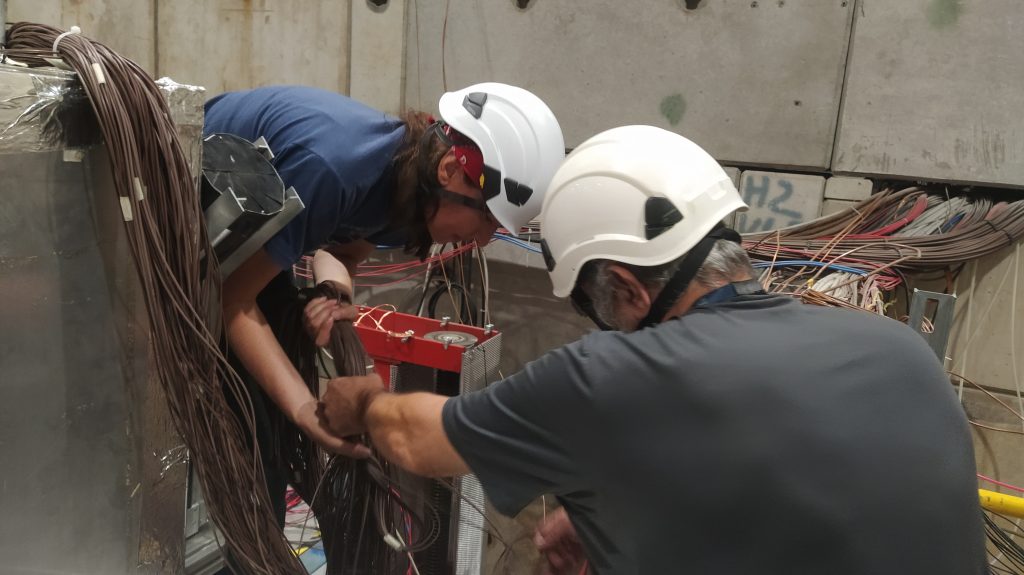
Two teams. One goal
The work builds on decades of detector research. Many of the scientists involved have collaborated for very many years, laying the foundations for the current effort. As Madrid puts it, the project is “the continuation of a great idea.” Over the next few years, the aim of the researchers is to converge on a single dual-readout calorimeter concept that combines the strengths of each design that could form the basis of a future FCC-ee experiment operating in the second half of the 2040s. “If we couple our timing capabilities with the Italian prototype, we will have a detector that’s better than both of ours,” concludes Madrid.