
“The FCC-ee could open the Pandora’s box to understand the details of the Higgs boson” – Portrait Matthew McCullough
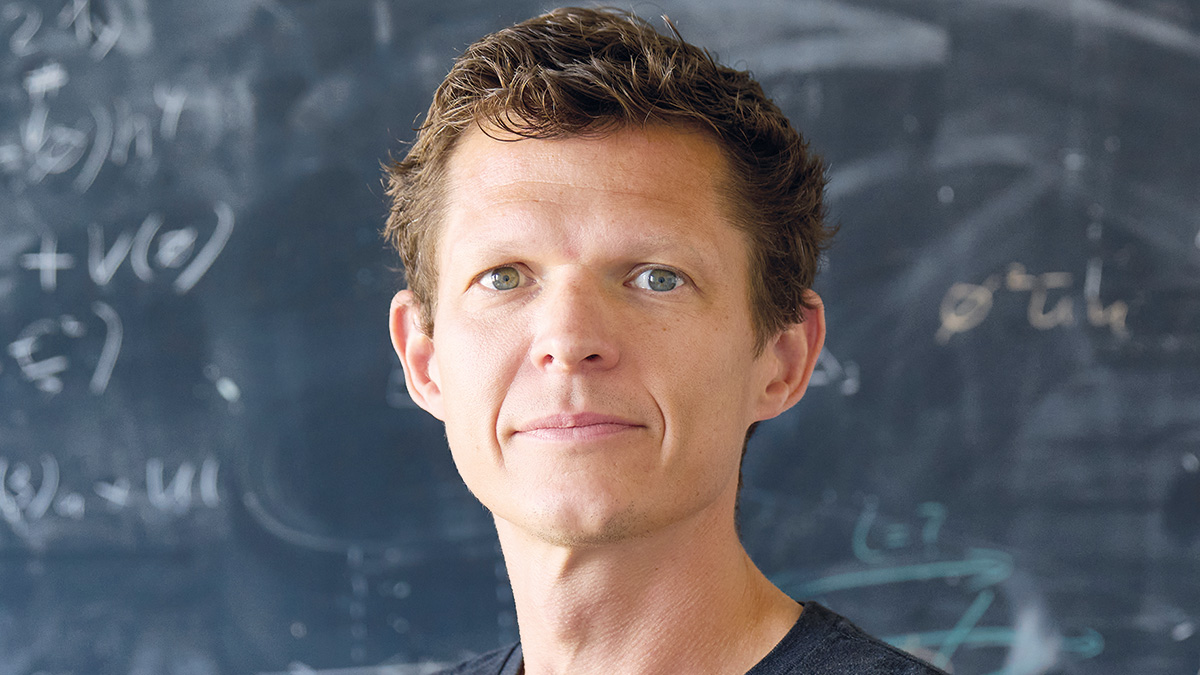
Born in Belfast and inspired by his brother, Matthew McCullough arrived at CERN in 2015 to develop theoretical studies on Beyond Standard Model physics and on the compositeness of the Higgs boson.

Where does your passion for physics come from?
I have a brother three years older than me. When I was a child, one day, on his bedside table, he had “A Brief history of time,” by Stephen Hawking. I remember asking him what that book was about. He replied quite forcefully: “You will never understand what this book is about.” But I took his answer as a challenge. I wanted to understand the physics behind the book. I applied for physics in some places and also to music studies in other places. At the very last moment I decided to go down the physics route and moved from Belfast to Oxford. I’m very glad about my decision.
Was your brother a source of motivation?
My brother was also very interested in mathematics, physics, science, and engineering and in understanding why things work the way they do. As a young child I already loved playing with mathematics, but I absorbed a lot of that interest and enthusiasm from him. I think he triggered in me a genuine interest in fundamental physics.
In Oxford you discovered theoretical physics.
After my undergraduate studies, from 2007 to 2011, I did a PhD in theoretical particle physics with John March-Russell, a professor in Oxford. He is a very creative model builder, coming up with new theories to explain certain fundamental questions about nature. At that time, I mostly worked on dark matter and other topics in beyond the standard model (BSM) physics. Then I went to MIT for three years and worked with Jesse Thaler, also mostly on model building.
Then the Higgs boson was discovered. What was the impact on your career?
In the past I worked a lot on dark matter. The exciting thing about dark matter is that we know it is there. However, there is no guarantee that we are able to ever detect it. And around the time of the Higgs discovery, I sat back trying to define a plan for my future research program for the coming decade. I realized that by studying the prospects for Higgs physics through the lens of BSM questions, I wanted to know about whether the Higgs was composite. If it is, then that should show up by the 10 TeV scale.
❝
If the Higgs boson is composite, it should show up by the 10 TeV scale”
How did you end up working in the FCC project?
I realized that, while the LHC is an incredible machine, it was going to leave lots of BSM questions unanswered. At the same time, I found the TLEP and the ILC proposals. It was very exciting the possibility to increase the precision of some measurements by an order of magnitude. When I was still at MIT, I started writing papers on the implications of the Higgs precision program at machines such as the FCC. In particular, I wrote a paper on the Higgs self-coupling, which generated a lot of interest.
When you arrived at CERN, did you get directly involved in the project?
When I came to CERN and I spoke to some people, I got even more interested in the FCC project. Actually, I was very interested in any of the proposed Higgs factories that could answer some of these questions I had about the Higgs. But to me, the FCC seemed the most reasonable option, in particular thanks to the large number of Z-bosons that it will produce and the precision in flavour physics. I naturally became involved.
But at that time the project did not look as it looks today.
I would say that while today it looks very promising, 10 years ago it was not clear that the project would get this far. I saw that people were using very basic arguments for trying to justify such a machine. I believed that by exploring the strong physics potential, one could better justify building it. For me, it was the natural thing to do it from a curiosity-driven perspective.
The LHC showed no signs of supersymmetry. Is there a bit of disenchantment about theoretical physics?
This is a question we discuss internally a lot. I started my career at the tail-end of the SUSY era. I remember when members of the theory department in Oxford were discussing the new limits coming out for squarks. And I saw the change happen very quickly. I think the excitement about supersymmetry and unification was well justified. However, nature is the final arbiter.
Is there a lack of new and radical ideas?
The results of the LHC push theorists to approach particle physics from a different perspective. There has been a huge amount of creativity, right across the scale of how radical one is willing to be. But currently, there is not one single theory where everyone is putting their bet on. When you go to conferences, you do not find big fashionable theories that everyone is discussing about physics beyond the standard model. There is really enormous diversity. And if you look at the past, that usually reflects historically very healthy times in science.
So no superstars or super theories.
Exactly. And that is absolutely fine. People are trying new ideas. Even ideas that don not fully fit into the current scientific landscape. I think that, as a community, we are much more receptive than we would have been in the past when there was such strong theoretical preconceptions being placed on something that was considered central. My view is that the field is very, very healthy.
You said this has been reflected throughout history.
Yes. For instance, questions surrounding the nature of light and its propagation led people to think about the existence of the ether, like Michelson and Morley. The finger was being put on the right question, even though the theory that was expected to be discovered was not the correct one. When you read Einstein’s first paper on relativity, in the second or third paragraph he refers to the Michelson-Morley experiment. Perhaps we are just having our “ether” moment. The questions are right and the experimental strategy is correct, but the answer is going to be something that we did not anticipate.
❝
Perhaps we are just having our “ether” moment.”
What would be the discovery you would like to see in your lifetime?
Realistically, taking the current experimental and theoretical landscape, again, the Higgs ZZ coupling measurement is a very important focal point in fundamental physics. The HZZ is a very well-known process, and we trust that measurement. The FCC-ee could perform that measurement with 15 sigma. That level of precision would be irrefutable to say that the Higgs is composite. Then it would open Pandora’s box about understanding the details of the Higgs boson.
There the FCC-hh would have a lot to say.
In this case, from the physics point of view, the FCC-hh will be immediately justified. I think the FCC-hh is the most realistic next option to go to high energies and the most feasible. But maybe we would have even stronger magnets, and we could go to higher energies. It’s easy to project progress linearly, but we see, for instance, with the advent of AI, that occasionally in technology we have phase transitions, step function changes in technology. I think a lot can change.