
“It is beautiful when theorists and experimentalists work together” – Portrait Sophie Renner
Convener of the Beyond Standard Model group of FCC-ee, Sophie Renner recently gave a lecture at the BNL-CERN School at Future Colliders. We talked with her about the school and the BSM theory prospects of the FCC-ee.

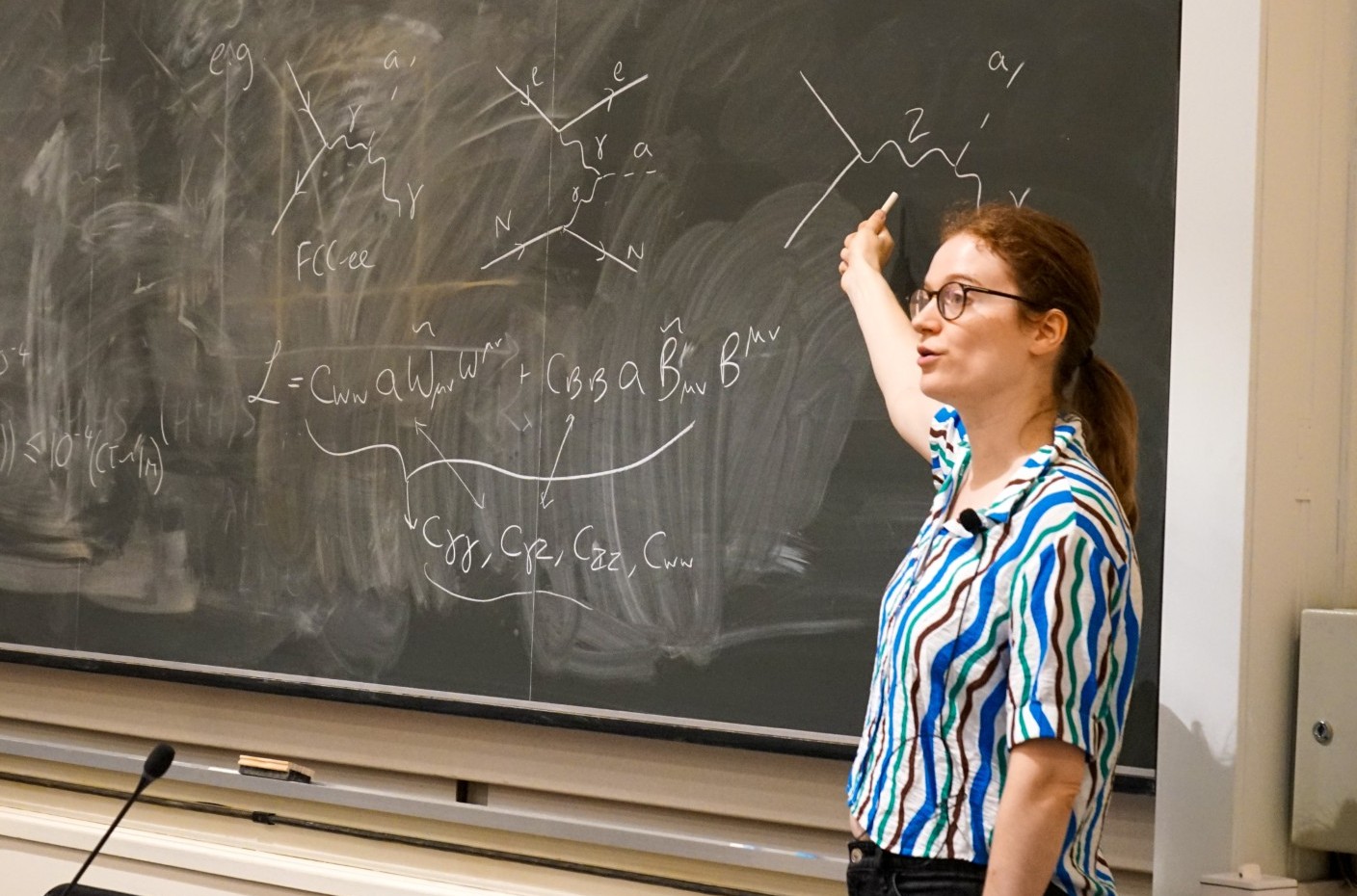
Originally from Streatham, in South London, Sophie Renner is a senior lecturer at the University of Glasgow. She is a convener of the Beyond Standard Model (BSM) physics group at the FCC-ee, and recently, she participated as a lecturer at the BNL-CERN School on Physics at Future Colliders that took place at CERN from the 26th of August to the 4th of September.
How did you end up teaching at this BNL-CERN school of Physics?
I am one of the conveners of the BSM group of FCC-ee. The organizers of the school asked me to give lectures on BSM for Future Colliders. I narrowed the scope down to FCC-ee mostly because that is what I have been working on recently.
What is your role as a convener of the FCC-ee project?
Part of my role as BSM convener is to make sure that all these different research groups are talking to each other and understand the shared implications of their analyses so that we can all get a full picture of the current development from both the theory and experiment sides. This involves organising regular online and in-person meetings to hear about latest progress and discuss next steps.
The program of the BNL-CERN School is quite diverse. How did you prepare your lectures?
It was quite difficult to prepare and give the lectures because the students came from a range of different physics backgrounds so you could feel that there were some people who already knew everything on the topic and some people for whom it was actually quite difficult to follow. I tried to get that balance. In any case, I think it is very nice that the program of the school brought so many subjects together. It gives people like me an introduction to accelerator physics, for example, which I do not know anything about.
How did you find the balance?
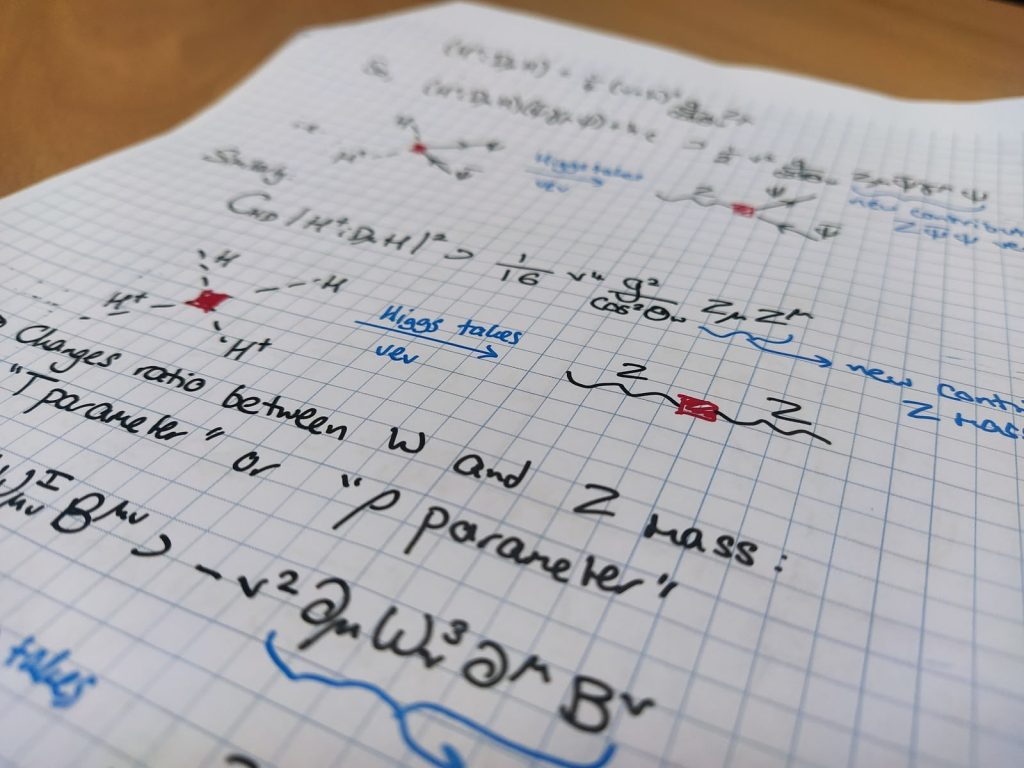
I wanted to give the experimental students an insight into the language and the thought processes that theorists have about FCC. I wanted to explain what an effective field theory is and how it applies to the FCC so that they can see how to interpret measurements in that language. I aimed to make it understandable to everyone, but not staying away from the more technical aspects.
Is there a gap between theorists’ and experimentalists’ thought process?
Sometimes there is this kind of different language between how they think about concepts. I think it is really important and really beautiful when theorists and experimentalists work together.
You only had two hours of lectures.How did you select the most relevant topics?
There are two dimensions to BSM physics at FCC-ee. The first are indirect tests of BSM through the unprecedented precision on Z and Higgs couplings. Then FCC-ee will also be very good at directly looking for light new physics that we might have missed in previous experiments. In my lectures wanted to give a very quick overview of both as well as relevant theories and signatures.
You gave the lecture with blackboard chalk. Do you always teach like that?
Yes. With theoretical physics lectures there is often the feeling that when you put equations on the slides, people are just gonna glaze over, and you rush through them. This does not happen when you have to write them on a blackboard and talk through each step.
I attended your second lecture and I loved your relaxed pace.
This way you make sure you are not going too fast. I ended up skipping some of the content that I prepared. But I think it is more important that people get the time to ask questions, and you can make sure that people are really following.
How was the students’ engagement?
It was really good. I have had lots of questions. You can tell by their questions that some people were very experimental and some people very theoretical. I have been really impressed with the participation.
If there is another edition of this school, would you like to participate again?
Yeah, I would. I have really enjoyed it. The students are really enthusiastic and interested, and I think schools like these are an important part of training people for the future direction of the field. I think that the plan is to do another one next year in the US.
How do your lectures relate to your research?
I work on all aspects of Beyond the Standard Model phenomenology. In the past, I have worked on flavour physics, and how can BSM show up in decays of B mesons, mainly. In the past few years, I got interested in what we can do at FCC, particularly in the Z-pole run. There you will have a huge number of Zs and you can get a lot of indirect sensitivity to all kinds of BSM models, as well as a very exciting flavour programme.
What are your personal expectations of finding new physics at FCC-ee?
That is a difficult one to answer. I think it would be surprising if everything looks Standard Model-like, particularly in the indirect sensitivity from the Z and the Higgs. I think that we have a very good chance of seeing the first signs of a new theory at FCC-ee. I am optimistic.
Upcoming workshop on Beyond the Standard Model at FCC-ee
From the 23rd to the 25th of September, CERN will host a meeting that will cover all aspects of BSM physics at FCC-ee, including both indirect sensitivity to heavy new particles from precision measurements, and direct searches for light new particles. In this workshop, theorists and experimentalists will give updates on research progress, and an open discussion will agree on priorities and next steps for focus topics. Anyone working on or interested in BSM physics at FCC-ee is encouraged to register here!