
Granular Calorimeters for the FCC-ee warms up
The FCC-ee ALFA detector concept proposes a novel calorimeter technique based on small scintillating crystals. This technique may provide exceptionally fine spatial resolution.

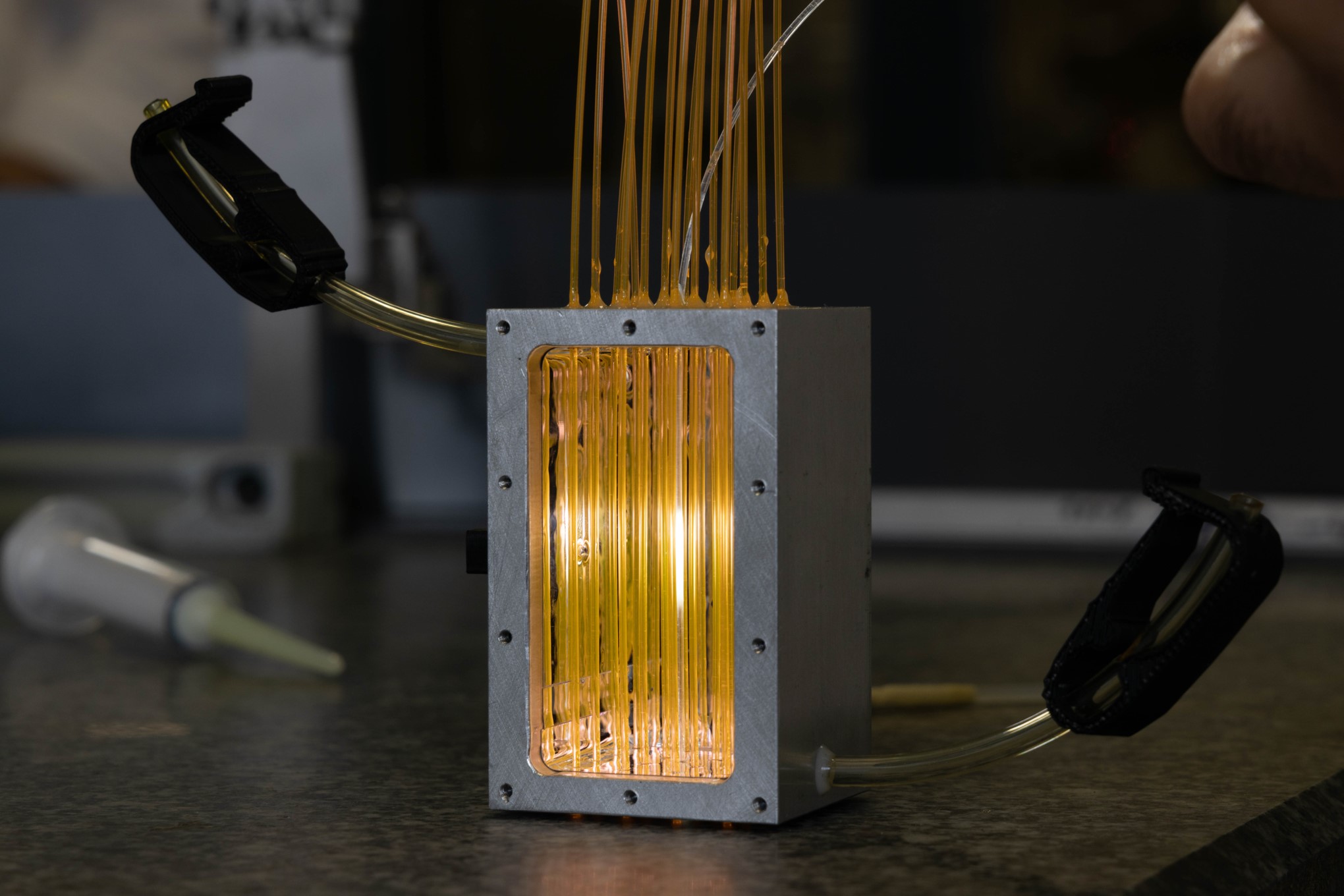
Six FCC-ee detector concepts are currently under study. Some of these concepts inherit the design and technology of previous projects while others have been developed specifically for FCC-ee. Their designs, specifications and technologies are therefore tailored to FCC-ee requirements from the outset. This is the case of ALFA (Advanced Lightweight and Fine-grained Apparatus), a detector concept created exclusively for FCC-ee.
Among the different sub-detectors, the ALFA concept proposes a novel calorimetry system based on fine scintillating crystal grains. Using this technology, the so-called GRAiNITA concept aims to provide high energy resolution and fine transverse position resolution. “The electromagnetic calorimeter is perhaps the biggest challenge of the project,” says Duccio Abbaneo, coordinator of the ALFA detector concept project. To address the challenge, for several years, the Orsay and Clermont Universities in France and the Institute for Scintillation Materials (ISMA) in Ukraine have already been conducting R&D activities on the concept. The CERN FCC-PED group has joined this effort since a year.
Calorimetry using small crystals
Traditional high-sampling calorimeters usually consist of large homogeneous crystal blocks. These monolithic structures provide excellent energy resolution, but obtaining very fine-grained information about the development and position of the shower requires a large number of readout channels and careful segmentation. “This technique is unbeatable for recording particle energy. However, very little is known about the transverse or the longitudinal distribution,” says Stéphane Monteil, Professor at Clermont University (France).
To cope with this limitation, the GRAiNITA concept, initially proposed by Jacques Lefrançois, researcher at IJCLab, is composed of large numbers of fine crystal grains with fibers that read the scintillating light close to the location where it is produced. This concept measures the energy deposited in individual grains, making it possible to reconstruct the spatial distribution of the shower. To manufacture it, the oxide precursors are dissolved into a molten flux. The temperature is then raised, allowing crystals to form. Depending on the temperature at which the process is stopped, the resulting crystals can be smaller or larger. Currently, the ISMA is in charge of producing these crystals for the prototypes and the future demonstrator.
Prototype testing
In 2024, a small prototype with a 2.8 × 2.8 cm² cross-section and a length of 5.5 cm was tested both with cosmic rays and at the SPS H9 muon and pion test beam in the CERN North Area. The prototype, filled with 200 grams of ZnWO4, had sixteen reading fibres spaced 7 mm that collected and transported the light generated at the crystals. “The first goal of the tests was to check that the photostatistics permits a stochastic energy-resolution target at 2%/E, corresponding what we can achieve with homogeneous detectors,” says Monteil.
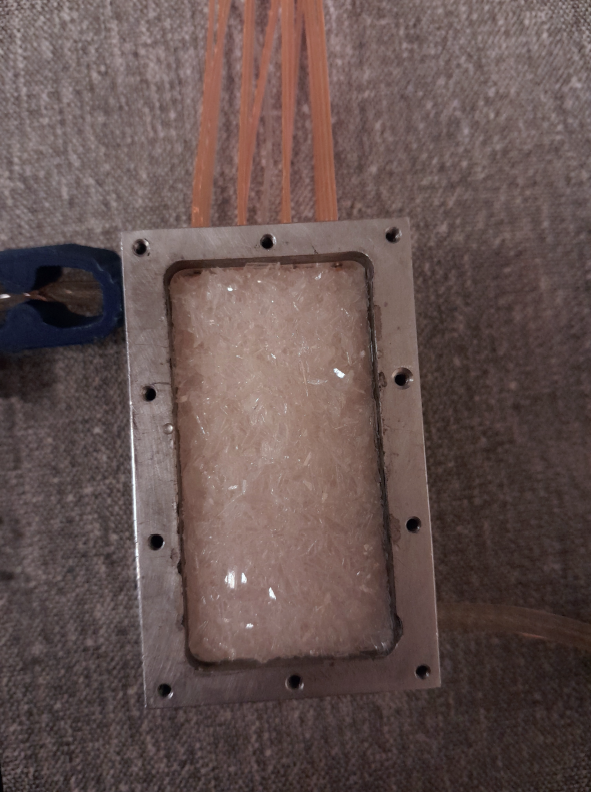
Another aspect researchers wanted to test is whether the non-uniform arrangement of grains and fibres could bias the measurement of the shower position or energy. The tests were very promising, and revealed that the resulting systematic effect was well below the level of tolerance for the precision required at FCC-ee. “Even with this simple prototype we showed that the concept works well,” says Monteil.
Several challenges ahead
The next major future milestone of the GRAiNITA project is to demonstrate that the performance observed with the small prototype can be reproduced at the scale required for the FCC-ee calorimeter. A full-size electromagnetic calorimeter module demonstrator is currently under construction. Measuring 17 × 17 × 40 cm³ and containing 45 kg of crystal grains, the demonstrator will bring together the grains, fibres and a heavy liquid that surrounds the material at a scale much closer to that required for FCC-ee. It will allow the team to assess the performance and practical feasibility of the complete system.
One of the challenges is to withstand the mechanical constraints that a 200-tonne detector imposes. “The idea is to fill the space between the grains with something that is as heavy as possible,” says Monteil. The filler material contributes to the absorption, allowing the calorimeter to contain the shower while keeping the overall detector compact. To this end, R&D has already started on different types of resins, while denser materials such as lead glass are also being considered to make the whole detector more compact. Another major challenge to overcome is the production of 200 tonnes of crystals. The production of such an amount of crystals requires an industrial facility such as the one provided by the ISMA.
Another challenge is the longitudinal segmentation of the calorimeter. Unlike the transverse segmentation, which comes naturally from the arrangement of the grains and fibres, separating the calorimeter into layers along the direction of the incoming particle requires additional design choices. The team is exploring several possibilities, including modifying the fibres to create a pre-shower section that could provide information on the early development of the particle shower. How to implement an effective longitudinal segmentation while preserving the advantages of the granular design remains an open area of R&D.
A potential dual readout system
The team is also investigating whether the signal produced in GRAiNITA could be used to distinguish electromagnetic and hadronic components of a shower. If confirmed, this could open the door to a dual-readout calorimeter, an approach also being explored by other FCC-ee detector concepts. “It is still speculative, but by introducing the measured scintillation responses of low-energy shower particles in simulations, we are able to determine the electromagnetic fraction in a high-energy hadron shower and improve the hadron energy measurement,” says Monteil.
References
- Studying the GRAiNITA concept: first test beam results – IOPscience
- Monteil talk during the BNL-CERN School on Physics for Future Colliders: https://indico.cern.ch/event/1664041/contributions/7058767/attachments/3285721/5873281/ALFA_01June2026.pdf
- Duccio Abbaneo’s seminar on the ALFA detector concept: Advanced, Lightweight and Fine-grained Apparatus (ALFA) for e+e- physics (Duccio Abbaneo, CERN)