
FCC-PED goes to Asia
Researchers from the FCC-ee project attend conferences in China and Korea to explain the detector and physics capabilities of the project and foster transcontinental collaboration.

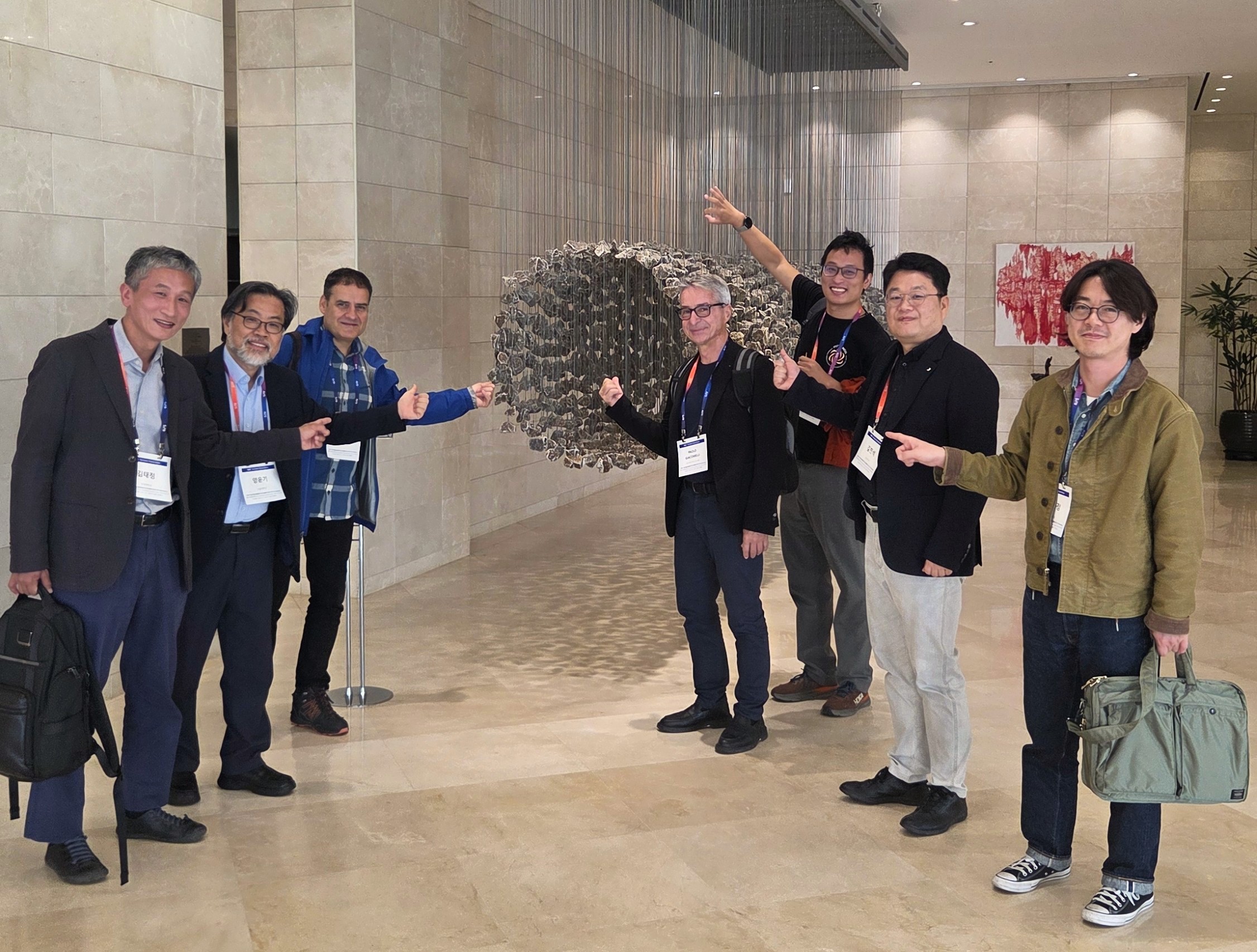
From 20 to 26 October 2026, two major scientific meetings took place in Asia: the Fall Meeting of the Korean Physical Society, held on Jeju Island (South Korea), and the CEPC Workshop, held in Shanghai (China). Both conferences featured high-level presentations on the FCC-ee programme, providing valuable opportunities to raise awareness of the project and strengthen its engagement with the Asian high-energy physics community.
The Fall Meeting, one of the major annual gatherings of the Korean physics community, attracted more than 1,000 participants and included a dedicated “Pioneer Symposium” session on the FCC-ee project with more than 70 high-energy particle physicists. David d’Enterria (CERN) and Paolo Giacomelli, INFN researcher and leader of the IDEA detector concept, presented overviews of the FCC-ee physics programme and detector concepts, respectively.
David d’Enterria highlighted that “the presentations attracted considerable interest from the Korean HEP community and provided an opportunity to discuss potential avenues for closer scientific collaboration”. These exchanges are particularly timely in the context of ongoing efforts to strengthen ties between the FCC-ee collaboration and Korean institutions, including Korea’s plans to pursue associated membership in the project.
While the conference in Shanghai was focused on the recent developments of the CEPC project, it included dedicated talks on the recent status and development of the FCC-ee project. “This seemed like the best way to showcase China’s recent addition to the FCC-PED community,” says Giacomelli who co-chaired two of the experimental sessions and gave a summary talk on the six FCC-ee detector concepts. During this talk, Giacomelli presented the specific timescale for FCC-PED and the various achievements and synergies across the different detector concepts, which were presented in dedicated talks in previous sessions. “We believe that China can bring important contributions to FCC-PED and we are eager to exploit the synergies discussed at the workshop,” concluded Giacomelli.
References:
- 2026 International Workshop on the High-Energy Circular Electron-Positron Collider (CEPC2026) https://indico.ihep.ac.cn/event/28911/
- The Future Circular Collider: Physics, Technology, and Korean Contributions
https://indico.global/event/19545