
Bringing the FCC community closer together
The FCC-PED General Meeting brings together researchers from across the collaboration to discuss the developments, constraints and requirements shaping the project as it progresses through the Reference Design Phase.

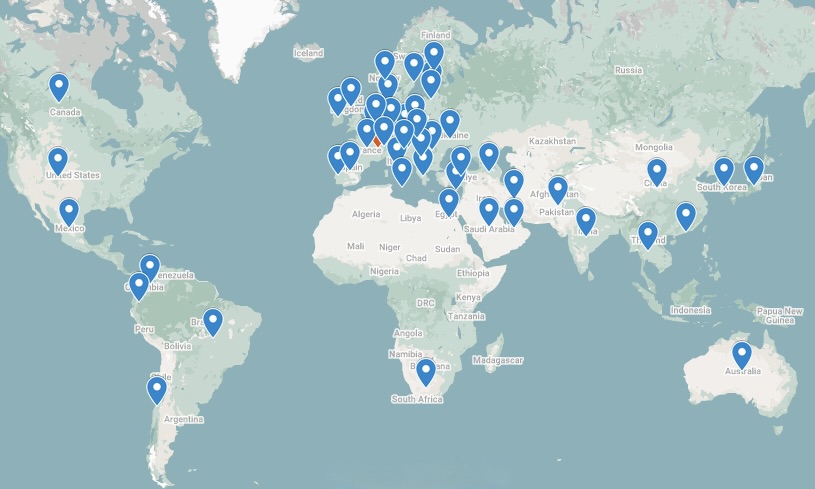
During the FCC Feasibility Study, the focus was on demonstrating the project’s scientific potential and establishing the parameters needed to assess its performance. The organization of the FCC-PED group reflected these objectives, with higher focus on the separate research areas. As the FCC-ee moves towards a realistic design, physics goals must increasingly be considered alongside detector technologies, computing requirements, accelerator constraints and budget. This calls for closer collaboration across disciplines to turn the project’s scientific goals into a workable design. “The Reference Design Phase is not just about physics. It involves precise technical requirements for the machine and detectors, as well as budgetary considerations,” says Patrizia Azzi, researcher at INFN Padova and one of the coordinators of the FCC-PED Physics Studies group alongside Michele Selvaggi, Matthew Mc Coullogh, David D’Enterria, and Jorge De Blas.
A change in working culture
During the FCC feasibility study, the Physics Programme work package —related to the theoretical opportunities— and the “Physics Performance” work package —focusing on making sure we could build detectors to guarantee those packages— were organized independently. For the FCC-ee, these two areas need to work with an even higher synergy, as developments in one area directly affect the other. Monte Carlo simulations, for instance, help physicists study theoretical processes while also assessing the detector capabilities needed to measure them. According to Azzi, this closer interaction reflects the needs of the Reference Design Phase.
The organization of the physics groups is thus evolving accordingly. Groups are organized around specific topics, making it easier to identify where theorists and experimentalists need to work together. At the same time, software, computing and detector teams are also developing more structured ways of collaborating through meetings and dedicated workshops. This new organization has already started to bring in a broader collaboration, allowing new conveners and contributors to join, including people who were not previously involved in the FCC-ee and young researchers.
A forum for the whole community
The FCC-PED General Meeting is intended to provide a shared overview of developments across the different working groups and to help participants understand how decisions in one area affect the others. Detector design, computing, simulations and accelerator conditions all influence the physics programme, making exchanges across these fields increasingly important.
The meeting aims to combine technical depth with accessibility. Participants should be able to follow developments beyond their own area of expertise while remaining informed about the constraints, limitations and requirements being discussed across the collaboration. As Azzi puts it,
❝
“We need a forum where everybody is informed of the most important conditions, limitations and requirements being discussed.”
— P Azzi
Looking ahead
The coming months will see further studies on reconstruction and tracking, more realistic simulations incorporating backgrounds, and additional comparisons with existing experimental data. As these studies progress, new questions and technical requirements will emerge, making exchanges across the wider community increasingly important. The format of the new FCC-PED General Meeting will evolve as the project progresses through the Reference Design Phase, with the aim of supporting the collaboration as it works towards the FCC’s targeted approval in 2028.
First FCC-PED General Meeting
The first FCC-PED General Meeting took place on Thursday 1 October, bringing together members of the different FCC-PED working groups to share news and developments across a range of topics, from physics and detectors to computing and the machine–detector interface (MDI).
The meeting was chaired by David d’Enterria, Jorge de Blas, Matthew Philip McCullough, Michele Selvaggi, and Patrizia Azzi. Researchers presented updates on several topics:
- FCC-PED project leaders Christophe Grojean, Guy Wilkinson, and Patrick Janot shared recent news on PED coordination.
- Brigit Stapf gave an overview of the main ideas discussed during the FCC-hh workshop, held at CERN on 22 September.
- Sophie Renner summarised the discussions from the BSM workshop, which took place at CERN from 23 to 25 September.
- Jan Eysermans presented preliminary studies of the physics requirements for inner detectors relevant to the design of the machine–detector interface (MDI).
For further details, see the event agenda: https://indico.cern.ch/event/1733820/