
Machine Detector Interface: the frontier between two worlds
It is part of the machine. It is part of the detector. It belongs to both yet stands on its own. The Machine Detector Interface is a key element of the FCC-ee project. Its design must ensure high luminosity, low beam-induced backgrounds in the experiments, and safe operation.

The Machine Detector Interface (MDI) sits at the transition between the accelerator and the detector, around the interaction point (IP). Its design is extremely important: “The MDI is the key link between the collider and experiments, pivotal for the success of FCC-ee” says Manuela Boscolo, senior accelerator physicist at INFN and CERN and one of the two MDI coordinators of the FCC-ee project. To this end, all the elements of the MDI are designed to maximally exploit the physics program, in particular for ensuring the target luminosity at the Z-pole and other energies.
But the MDI is not only a section of the accelerator particles must travel through before they reach the detector. It is also an essential tool to protect the detector from backgrounds induced by the beam and synchrotron radiation. The goal during the Reference Design Phase is to provide a design as detailed as possible of the MDI layout to prove that the detector and the accelerator can meet all the requirements of the FCC-ee program [1].
Balancing competing requirements
The inner doublet of final focus quadrupoles (FFQ) squeezes the beam to very small sizes at the interaction points (IPs). In the FCC-ee, the last focusing quadrupole will be located at a distance of about 2.4 meters from the IP. That means that part of the inner doublet, composed by the two final quadrupoles, is placed inside the volume of the detector. In this context, the MDI also involves the design of a solenoid compensation scheme, which compensates for the magnetic fields generated by the detector solenoid. This includes the design of the screening solenoid, which shields the FFQ fields from the solenoidal field. “Any distortion in the field will eventually distort the beam and will reduce luminosity or the precision with which you can reconstruct an event,” says Giulia Nigrelli, PhD student at CERN, INFN-LNF, and Sapienza University studying the beam-induced backgrounds at the FCC-ee.
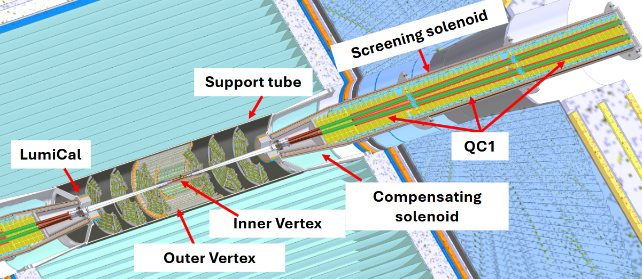
These low-β quadrupole magnets are very sensitive to any disturbance, including ground motion and misalignment. In addition, researchers plan a movable system that allows them to insert and extract these quadrupoles after opening it for access for maintenance of the detector. For that reason, alignment of the whole MDI and the components around it is key to ensure its performance. Besides the standard alignment of the machine components, the FCC-ee will also require an active alignment system to use a beam-based methods to precisely correct the beam trajectory and ensure the highest luminosity.
Researchers envisage a common MDI baseline for all working points (Z, WW, ZH and top pairs) and hopefully across the different interaction points and detector concepts. Nevertheless, differences between detectors might force different integration solutions with accelerator components. The requirements from the vertex detector demand the smallest possible beampipe radius to maximize the angular acceptance of the experiment and the precise reconstruction of tracks and vertices. However, a very small radius exposes the detector to the risk of receiving large amounts of radiation, hence the design of the MDI needs to maximize the largest acceptance while maintaining the smallest radiation possible. In addition, the design of the magnets’ cryostat of the FFQ must ensure reaching the largest luminosity with the smallest dimensions, not to compromise the detector acceptance. All these factors make the design and integration particularly challenging.
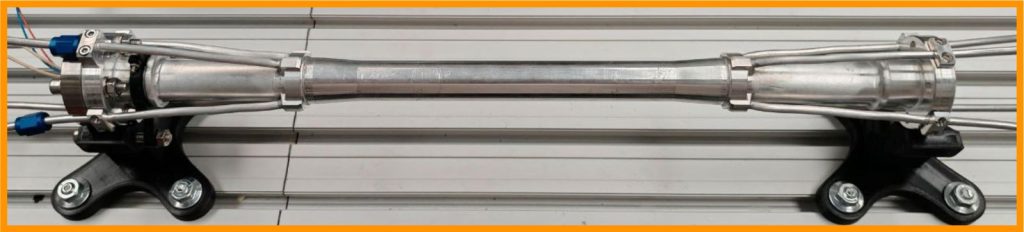
A FCC-ee IR MDI mockup under construction
To study the details of the MDI and its integration within the whole machine and detector systems, a team of scientists and engineers led by Manuela Boscolo, are building a mockup of the FCC-ee interaction region (IR) at the INFN National Laboratories of Frascati in a project co-funded by INFN and CERN.
The IR mockup consists of a full-scale prototype of the IR. The central and tapered beam pipes have been built in aluminum instead of the aluminum-beryllium alloy (AlBeMet) foreseen for FCC-ee for about +/-1.5 m. It includes a realistic prototype of the beam pipes and the bellows, integrated with the vertex detector and the luminosity calorimeter through a novel concept of support tube [2]. The central part of the mockup is almost completed and consists of a liquid paraffin-based cooling system between two electron-beam-welded (EBW) layers of the central chamber that extract the beam heat load. The tapered EBW beam pipes with the water-cooling system have already been delivered to Frascati, and the efficiency of its cooling system is currently being tested. In parallel, at INFN Pisa, a team led by Fabrizio Palla, successfully assessed the experimental validation of the air-cooling system for the inner vertex detector.
The mockup will be used to experimentally qualify the cooling performance of the IR beampipes, the assembly procedure, and the structural resistance. A real integration test will show any interference between the inner detectors and the beam pipes. In the future, it could be used to test the alignment monitoring system or to extend it to components after the bellows. The full assembly sequence will be the final important step for the experimental validation of the MDI concept.
A collaboration between machine and detector experts
The design of the Machine Detector Interface requires accelerator and detector experts to reconcile requirements that can sometimes pull in different directions. Many aspects, such as simulation software, alignment strategy, background control, and special masks around the experiments to minimize background from synchrotron radiation, require thorough consideration from both sides. “We always try to find innovative solutions to reach the requirements. So far, we have not found any showstopper,” says Nigrelli. As the FCC-ee Reference Design Phase progresses, the MDI will remain one of the key interfaces where the accelerator and detector designs have to converge to ensure the performance of the FCC-ee.
References
[1] M. Boscolo, F. Palla, et al. “The FCC-ee interaction region, design and integration of the machine elements and detectors, machine induced backgrounds and key performance indicators.”
https://link.springer.com/article/10.1140/epjti/s40485-025-00117-3
[2] M. Boscolo, F. Palla, F. Bosi, F. Fransesini, and S. Lauciani, “Mechanical model for the FCC-ee Interaction Region”. EPJ Tech. and Instrum. (2023)
https://doi.org/10.1140/epjti/s40485-023-00103-7
For more detailed information about current MDI activities, check the MDI meeting Indico site: https://indico.cern.ch/category/5665/