
“We are no longer studying FCC-ee. We are preparing to build it.”
Following the European Strategy for Particle Physics recommendation of FCC-ee as CERN’s preferred next flagship collider, the project is moving from exploring possibilities to defining what could actually be built.

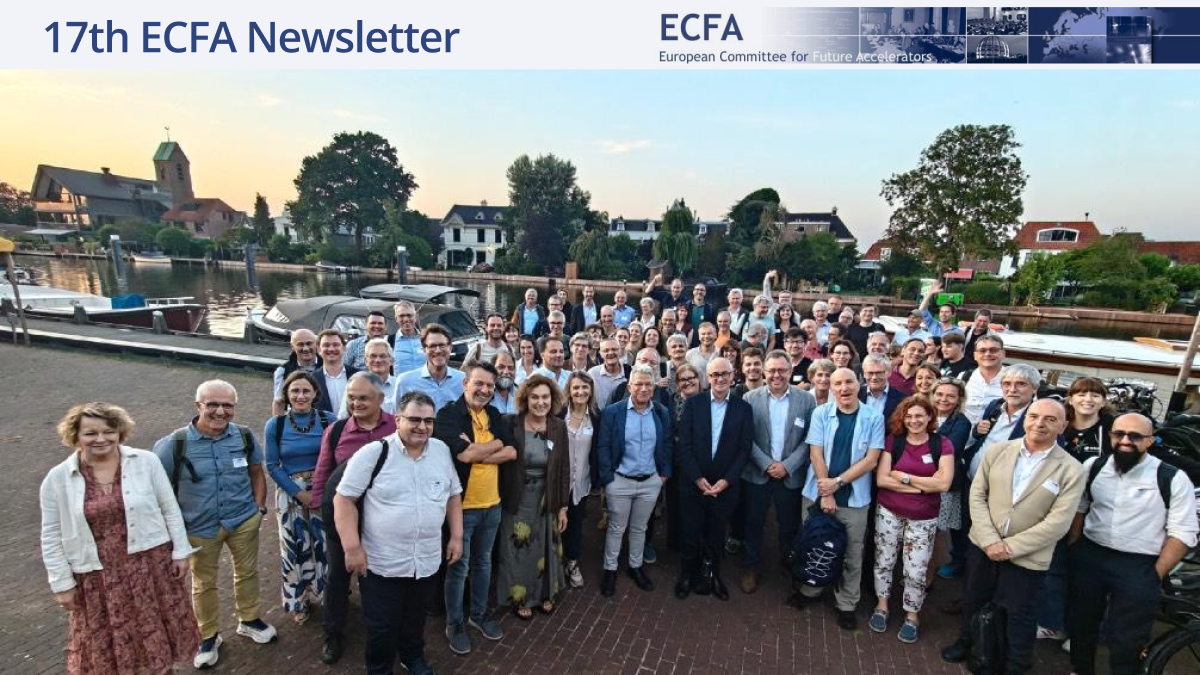
The FCC-ee project is entering a new stage. After years of exploring its physics potential and developing detector technologies, the focus is now shifting towards converging on the designs, technologies, and collaborations needed to build the experiments. At the latest ECFA plenary meeting, held from 9 to 10 July at NIKHEF, Patrick Janot, co-coordinator of FCC PED, set out how the FCC-ee detector programme will move from concept studies towards engineering-level designs and future experiment collaborations.
Between 2026 and 2028, this Reference Design Phase (RDP) will narrow down detector designs, compare technologies, assess engineering constraints and identify the R&D still needed to build the experiments. The strategy will focus on turning the results of the FCC-ee studies into concrete design choices. “Physics studies remain our compass, but they must now increasingly inform concrete design decisions,” says Janot. The goal is no longer to demonstrate what FCC-ee could achieve, but to ensure that it can deliver the precision required by its scientific programme when operations begin in the 2040s.
Designing realistic detectors
This strategy builds on the R&D currently carried out within the six detector concepts, focusing on developments that are meaningful to FCC-ee. More are expected to join, that will not be competing to become the final FCC-ee detector. Instead, the RDP will draw on the strengths of all to develop realistic experiment designs and identify the technologies and capabilities that should be carried forward. “As happened with the LHC, today’s detector concepts are expected to plant the seeds from which tomorrow’s experiment collaborations will emerge,” says Janot, who acknowledges that ECFA plays a key role in helping form these collaborations.
By the end of the Reference Design Phase, the different detector concepts should provide the necessary information to prepare multiple Expressions of Interest (EoIs) for future FCC-ee experiments. These EoIs are not intended to define the experiments that will ultimately be built. Rather, they will provide the framework within which ideas can mature, technologies can be compared, engineering constraints can be confronted with physics goals, and the necessary R&D can be identified.
This phase will also allow the exploration of ways of reducing technical risks, construction costs and programme duration. Moreover, these studies will examine how detector choices could support different implementation scenarios, including possible staging, while preserving the core scientific goals of FCC-ee.
❝
“Physics studies remain our compass, but they must now increasingly inform concrete design decisions”
— Patrick Janot
Two years of technology development and maturation
In the coming two years, FCC-ee detector technologies will mature into realistic engineering designs and common software and analysis tools will become fully operational. “In the past 15 years, we have shown that the FCC is scientifically compelling and technically credible. Now, we are no longer studying FCC-ee. We are preparing to build it,” concludes Janot.
Further information:
See Patrick Janot’s slides for the detailed strategy and recommendations.
You can read Patrick Janot’s and other related contributions in the:
17th ECFA Newsletter – Summer 2026
ECFA in a Nutshell
ECFA stands for European Committee for Future Accelerators. It is a scientific advisory body associated with CERN whose broad purpose is to help coordinate and shape the future of particle physics in Europe.
Its activities include:
- Advising on future particle-physics facilities and accelerators. This includes thinking about what technologies and infrastructure Europe will need after the LHC.
- Assessing the health of particle physics in European countries. Through its Restricted ECFA (RECFA), it conducts visits to CERN Member States, examining their research programmes, infrastructure, funding and workforce, and making recommendations to both the community and governments.
- Contributing to the European Strategy for Particle Physics, the process through which CERN and its Member States establish Europe’s long-term priorities for the field. ECFA nominates members to the strategy process and participates directly in it.
- Coordinating detector and accelerator R&D. ECFA has played an important role in roadmaps for the technologies needed for future experiments and colliders.
- Representing the interests of the particle-physics community, including early-career researchers. ECFA has, for example, an Early-Career Researchers Panel that advises it on issues affecting the future of the field and a Training Panel that supports schools of instrumentation.
The 118th Plenary ECFA meeting, held at Nikhef in Amsterdam on 9–10 July 2026, heavily focused on what happens after the 2026 update of the European Strategy for Particle Physics (ESPP).